
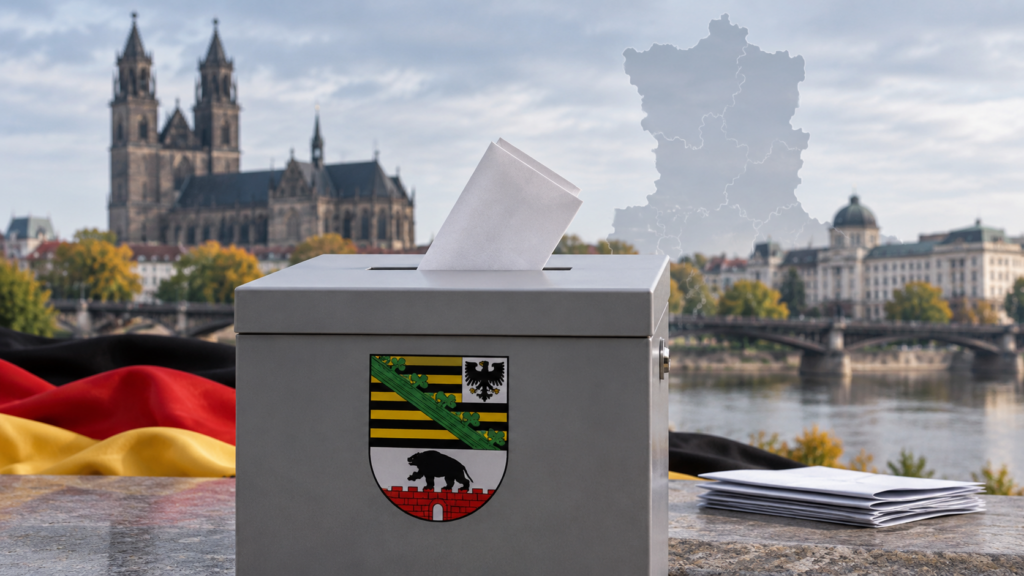
The AfD has won the 2026 state election in Saxony-Anhalt with 43.8% of the vote.
It secured 39 seats in the state parliament. However, it needs 42 seats for a majority.
This means the party cannot govern alone.
Official election results
All votes have been counted. The result remains provisional until it is formally confirmed on September 22.
The AfD finished well ahead of the CDU, which received 17.2% of the vote.
| Party | Vote | Seats |
|---|---|---|
| AfD | 43.8% | 39 |
| CDU | 17.2% | 15 |
| SPD | 9.3% | 8 |
| Greens | 8.9% | 8 |
| The Left | 8.6% | 8 |
| BSW | 5.3% | 5 |
| FDP | 2.6% | 0 |
The new parliament has 83 seats. A majority requires at least 42.
Voter turnout was 77.8%. In the previous election in 2021, it was 60.3%.
A major gain for the AfD
The result is a significant gain for the AfD.
The party received 20.8% in the 2021 election. Its share has now more than doubled.
The CDU suffered heavy losses. Its support fell from 37.1% in 2021 to 17.2%.
The FDP received only 2.6%. It failed to reach the 5% threshold and will not enter the state parliament.
AfD wins almost every constituency
Saxony-Anhalt has 41 direct constituencies.
The AfD won 38 of them. The remaining three went to The Left.
The CDU did not win any direct constituencies. All 15 of its seats came through the party list.
Who will form the next government?
The AfD is the largest party, but it is three seats short of a majority.
Its lead candidate, Ulrich Siegmund, will not automatically become Minister-President. He must first receive enough votes in the state parliament.
Germany’s main political parties have so far refused to govern with the AfD. Chancellor Friedrich Merz has also ruled out cooperation between the CDU and the AfD.
This leaves Saxony-Anhalt with a difficult political situation.
BSW could play a key role
The Sahra Wagenknecht Alliance, known as the BSW, won five seats.
Together, the AfD and BSW would have 44 seats. That would be enough for a majority.
BSW lead candidate Thomas Schulze has said his party could consider helping an AfD candidate become Minister-President. However, no agreement has been reached.
The other five parties in parliament also hold a combined 44 seats. But forming a government between the CDU, SPD, Greens, The Left and BSW would be politically difficult.
Coalition talks are now expected to begin.
Why this result matters
The AfD has never been part of a German state or federal government.
If the party manages to lead the government in Saxony-Anhalt, it would mark a major change in German politics.
The AfD’s Saxony-Anhalt branch has been classified as a confirmed right-wing extremist organisation by the state’s domestic intelligence agency. The party rejects this classification.
The result will also increase pressure on the CDU and Chancellor Friedrich Merz. The CDU lost almost 20 percentage points compared with the previous election.
What does this mean for foreign residents?
The election does not immediately change immigration or citizenship rules.
Residence permits, work visas, citizenship applications and most asylum laws are mainly regulated at federal or European level.
The election result also does not affect existing appointments or applications at immigration offices.
However, the next state government could influence areas such as:
- Integration programmes
- Schools and education
- State police
- Refugee accommodation
- Funding for social and cultural organisations
- Local administrative services
Any changes would require a government to be formed and new policies to be introduced.
Foreign residents do not need to take any action because of the election result.
What happens next?
Political parties will now discuss possible coalitions and other forms of cooperation.
The new state parliament must then elect the Minister-President.
The figures published on September 7 are the official provisional results. The state election committee is expected to confirm the legally final result on September 22, 2026.
Until a new government is formed, no laws or administrative rules will change automatically.
Sources
- Official Saxony-Anhalt election results
- Official seat allocation
- Official election FAQ
- Reuters: AfD seeks support after state election
- AP: Saxony-Anhalt election and possible coalitions
Published: September 7, 2026
Last updated: September 7, 2026